
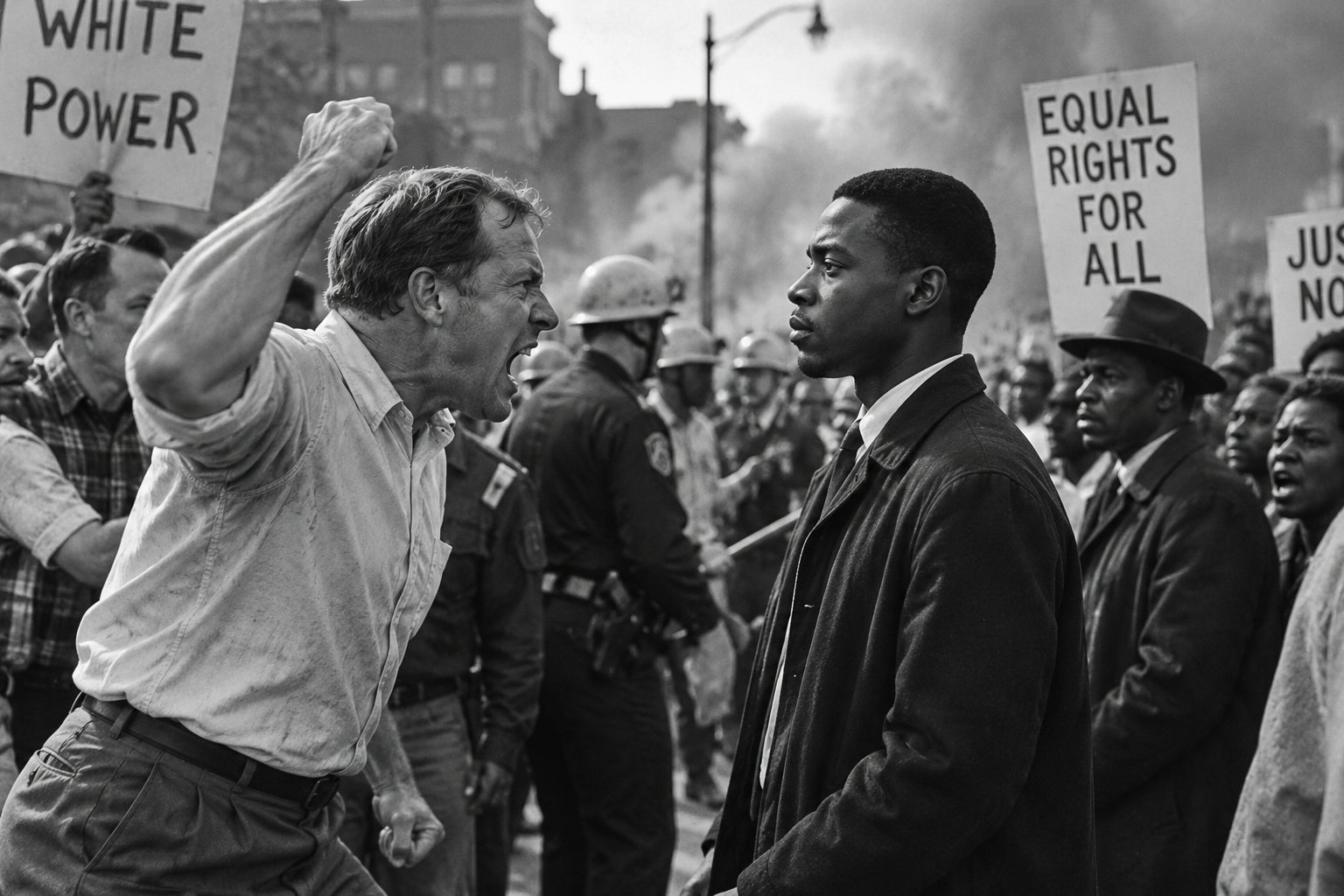
A Personal Story of Violence
For the last 15 years, my family and I have lived just off one of the most dangerous intersections in Minneapolis. It is a hub for gangs, drugs, prostitution, homelessness, and people struggling with mental illness—an environment among the most hateful and violent in Minnesota.
On the night of September 8, I called 911 because of gunfire outside our home, something that has happened at least five times over the years—sometimes while my wife or I stood on the porch, once with forty rounds sprayed across our lawn. But that night was different. From my window, I could not see into the darkness, yet within minutes, a flood of squad cars arrived. A man had been murdered. When I stepped outside, I saw his body lying on the ground. My heart was heavy with grief. Who could do such a thing? What condition of the heart makes murder seem like the best choice? These are not abstract questions; they invite us to wrestle with the nature of hate and violence.
That night left me asking bigger questions—not only about my city but about the human heart and God’s story. To wrestle with violence and hate, we must first define them and then place them within the larger arc of Scripture.
Definitions
To begin that exploration, we first need clarity on what we mean by these words.
Hate is the hardened desire to see someone or something diminished or destroyed, often born of anger, fear, or disgust.
Violence is harm inflicted outwardly, whether through direct force like murder or systemic evils like poverty.
Meta-Narrative
The story of Scripture unfolds as a sweeping meta-narrative: God desires a relationship with His creation, yet humanity often struggles to trust Him. God is self-sufficient, yet His character is inherently relational—He cannot help but share Himself. This desire for connection is evident from the very beginning: “Let us make mankind in our image, in our likeness, that they may rule over the earth” (Genesis 1:26). Humanity’s role in this divine plan is neither simple nor clean; it is marked by both failure and redemption.
God’s pursuit of relationship unfolds through a series of covenants. In the Garden of Eden, Adam and Eve were given one condition: not to eat from the tree of the knowledge of good and evil. Their disobedience introduced death into the story, and broken trust became a recurring theme in humanity’s narrative.
Soon, humanity strayed so far that God’s judgment became necessary, yet He did not abandon His creation. He chose Noah, rescuing him from the flood—a divine judgment on a corrupted world (Genesis 6:11). God promised never again to destroy the earth in that way, giving the rainbow as a sign of His covenant. Later, God called Abraham, promising to make his descendants as numerous as the stars. This covenant was rooted in Abraham’s extraordinary trust: he obeyed God even when asked to sacrifice his only son, Isaac. His faith was credited as righteousness.
Through Moses, God sought to draw His people closer after delivering them from slavery. At Mount Sinai, He invited the people to consecrate themselves and meet Him on the mountain. When they failed to come, Moses went alone and received the Law—a guide for living rightly in relationship with God. Centuries later, God allowed His people to have a king and established a covenant with David, promising that one of his descendants would reign forever.
In both expected and unexpected ways, the coming of the Messiah fulfilled all previous covenants. The curse of Adam, which came from broken trust, was undone through Jesus’ body and blood. Just as Noah offered refuge from destruction, Jesus provides safety to all who take shelter in Him. Abraham’s story of substitution finds its ultimate fulfillment in Jesus: where a ram stood in for Isaac, God Himself provides His Son as a substitute for humanity.
Jesus is the Word of God that assumed flesh, accomplishing what the Mosaic Law could not. The law itself was not weak, but human flesh could not fulfill it perfectly. As Scripture says, “For what the law was powerless to do because it was weakened by the flesh, God did by sending his own Son in the likeness of sinful flesh to be a sin offering” (Romans 8:3). As Messiah and Son of Man, Jesus assumes David’s throne and reigns eternally.
Through Jesus, all God’s promises converge, revealing both how to live and the very nature of God: sacrificial, self-giving, and devoted to humanity. His life, death, and resurrection inaugurated the New Covenant, culminating on Pentecost with the outpouring of the Holy Spirit.
In staggering mercy, God enters into human violence, bearing it Himself for the sake of all who trust in Him. His invitation remains: He calls all who have ears to hear to join Him in this story—a story of trust, redemption, and eternal relationship.
Before & After Violence & Hate
To understand violence and hate, we first need to consider their absence. In the Garden, God declares creation “good,” and humanity “very good” (Genesis 1:31). The world is marked by peace, harmony, and flourishing. There is no hint of hatred or violence: humans eat from God’s provision, tend the garden in trust, and live without guilt, shame, or estrangement. Only when Adam and Eve break trust does conflict enter the story, and from that moment, violence begins to stain human history.
This vision of peace returns at the end of the story. Scripture promises, “He [God] will wipe away every tear from their eyes. There will be no more death or mourning or crying or pain, for the old order of things has passed away” (Revelation 21:4).
Taken together, Eden and the New Creation show us that peace is God’s intent, while hatred and violence are intruders. Yet in our daily experience, violence feels normal. The real question is: how do we live faithfully in a world so different from what God designed?
Violence & Hate in Light of the Messiah
That truth matters not just in ancient Israel but on my street corner in Minneapolis. On September 8, hate and violence took the form of gunfire, and a man’s life was cut short. All violence and hatred occur between the Fall of Adam and Eve and the final judgment, but Scripture shows us two lenses through which to understand it: before the coming of Jesus and after. Throughout the biblical narrative, we see God manifest His reign through goodness in a world marred by sin, both before and now in Christ.
Jeremiah prophesied about the New Covenant, roughly 600 years before the coming of Jesus, the Messiah.
Jeremiah 31:31–34: “The days are coming,” declares the Lord, “when I will make a new covenant with the people of Israel and with the people of Judah. It will not be like the covenant I made with their ancestors when I took them by the hand to lead them out of Egypt, because they broke my covenant, though I was a husband to them,” declares the Lord. “This is the covenant I will make with the people of Israel after that time,” declares the Lord. “I will put my law in their minds and write it on their hearts. I will be their God, and they will be my people. No longer will they teach their neighbor, or say to one another, ‘Know the Lord,’ because they will all know me, from the least of them to the greatest,” declares the Lord. “For I will forgive their wickedness and will remember their sins no more.”
Here, we see that the New Covenant will differ from the Mosaic covenant. Why? Because the people repeatedly broke the Mosaic covenant. God recognized that humanity could not fully uphold the law, and this failure hindered their relationship with Him. This was not a flaw in the law itself but a limitation in human ability to obey it perfectly.
Jeremiah outlines four key promises of the New Covenant:
God will put His law in their minds and write it on their hearts.
God will be their God, and they will be His people.
All will know God, from the least to the greatest.
God will forgive their wickedness and remember their sins no more.
With Jesus, God reframes the law through a focus on love. When asked what the greatest commandment is, Jesus summarizes it in two principles: love God and love your neighbor as yourself (Matthew 22:36–40; referencing Deuteronomy 6:5 and Leviticus 19:18).
In His longest unified discourse, often called The Sermon on the Mount, Jesus further clarifies God’s intent regarding hate and violence:
Equating anger with murder: (Matthew 5:21–22) Jesus highlights that unresolved anger can lead to destructive outcomes, showing that hate begins in the heart.
Calling others “fools”: (Matthew 5:22; 12:34) Our words reveal our inner hearts, and harboring contempt or insult toward others is spiritually dangerous.
Non-retaliation: (Matthew 5:38–39) Instead of returning violence with violence, Jesus instructs His followers to offer “the other cheek,” a radical call to nonviolence made possible under the New Covenant.
Loving enemies: (Matthew 5:43–44) Jesus challenges the human tendency to love selectively, commanding love and prayer for persecutors as a reflection of God’s character.
Jesus models this sacrificial love personally:
Mark 10:45: “For even the Son of Man did not come to be served, but to serve, and to give his life as a ransom for many.”
John 12:24: “Unless a kernel of wheat falls to the ground and dies, it remains only a single seed. But if it dies, it produces many seeds.”
John 10:11, 15, 17–18: Jesus repeatedly presents Himself as the good shepherd, laying down His life voluntarily for His sheep, exercising both authority to lay it down and to take it up again.
The climactic moment of Jesus’ life aligns with the Passover feast, symbolically inaugurating His death and resurrection. Passover commemorates God's deliverance of His people from slavery in Egypt, sparing the firstborn through the blood of a lamb (Exodus 12:12). John the Baptist identifies Jesus as this Lamb: “Behold, the Lamb of God, who takes away the sins of the world” (John 1:29).
During the Last Supper, Jesus connects His impending death to the covenantal blood of the Old Testament:
Matthew 26:26–28: “While they were eating, Jesus took bread, and when he had given thanks, he broke it and gave it to his disciples, saying, ‘Take and eat; this is my body.’ Then he took a cup, and when he had given thanks, he gave it to them, saying, ‘Drink from it, all of you. This is my blood of the covenant, which is poured out for many for the forgiveness of sins.’”
This raises the pivotal question: Whose sins are forgiven?
Often Misunderstood Passages
Two passages are often misunderstood as endorsing violence. The first is Matthew 10:34: “Do not suppose that I have come to bring peace to the earth. I did not come to bring peace, but a sword.” Jesus is not calling His followers to arms; rather, He warns that loyalty to Him will create painful divisions, even within families. This becomes clear later when He rebukes Peter for using an actual sword: “Put your sword back in its place, for all who draw the sword will die by the sword” (Matthew 26:52).
The second is Revelation 19:11–16, where Christ is pictured with a sword from His mouth and a robe dipped in blood. The imagery is symbolic: the sword represents the piercing power of His word, and the blood is His own, shed in self-sacrifice.
Far from contradicting Jesus’ teaching, both passages reinforce it. They show that His victory does not come through physical violence but through truth, faithfulness, and the costly way of the cross.
Jesus’ Apostles' words:
“Love does no harm to its neighbor and so fulfills the law” (Romans 13:10).
“For the entire law is fulfilled in keeping this one command: ‘Love your neighbor as yourself’” (Galatians 5:14).
“If you really keep the royal law found in Scripture, ‘Love your neighbor as yourself,’ you are doing right” (James 2:8).
“In your anger do not sin”: Do not let the sun go down while you are still angry, and do not give the devil a foothold” (Ephesians 4:26).
“But now you must also rid yourselves of all such things as these: anger, rage, malice, slander, and filthy language from your lips” (Colossians 3:8).
“Everyone should be quick to listen, slow to speak, and slow to become angry, because human anger does not produce the righteousness that God desires” (James 1:19–20).
In light of all these exhortations, Paul’s words capture the heart of them all: “Love must be sincere. Hate what is evil; cling to what is good” (Romans 12:9).
Violence and Hate Before the Messiah
To understand violence and hate, we can trace the arc of Scripture from God’s original intent in the Garden to its ultimate fulfillment in Christ. In Eden, humanity lived in peace and harmony, without guilt, shame, or estrangement. Violence was absent. After the Fall, that ideal was broken, and humanity entered a world where hatred, fear, and conflict began to stain human history. Even in this fractured world, God’s justice persisted, often enacted through human agents—broken vessels and imperfect means. How else could divine justice enter history except through frail hands?
But with the arrival of the Messiah, who perfectly unites justice and mercy in His atoning sacrifice, everything changes. Jesus takes violence upon Himself, absorbing judgment so that vengeance no longer has to fall on others. In Him, eternal life has already begun—a life marked not by hatred or violence but by the nearness of God.
If this is true, what need remains for hostility toward others? Freed from the old cycle, we are invited to live sacrificial love in a world aching for peace. With that vision in view, we now turn to passages of Scripture that reveal how God’s story moves us from violence toward love.
Violence Passages
“Then he said to them, “This is what the Lord, the God of Israel, says: ‘Each man strap a sword to his side. Go back and forth through the camp, from one end to the other, each killing his brother and friend and neighbor.’” The Levites did as Moses commanded, and that day about three thousand of the people died” (Exodus 32.27-28).
“When the Lord your God brings you into the land … you must destroy them totally. Make no treaty with them, and show them no mercy” (Deuteronomy 7.1-2).
“Daughter Babylon, doomed to destruction, happy is the one who repays you according to what you have done to us. Happy is the one who seizes your infants and dashes them against the rocks” (Psalm 137.8-9).
“Do I not hate those who hate you, Lord, and abhor those who are in rebellion against you? I have nothing but hatred for them; I count them my enemies” (Psalm 139.21-22).
“Do not gloat when your enemy falls; when they stumble, do not let your heart rejoice, or the Lord will see and disapprove and turn his wrath away from them” (Proverbs 24.17-18).
Nonviolent and “Positive” Hate Passages
“Do not envy the violent or choose any of their ways” (Proverbs 3.31).
“He has shown you, O mortal, what is good. And what does the Lord require of you? To act justly and to love mercy and to walk humbly with your God” (Micah 6.8).
“For I desire mercy, not sacrifice, and acknowledgment of God rather than burnt offerings” (Hosea 6.6).
“He defends the cause of the fatherless and the widow, and loves the foreigner residing among you, giving them food and clothing. And you are to love those who are foreigners, for you yourselves were foreigners in Egypt” (Deuteronomy 10.18-19).
“It is a sin to despise one’s neighbor, but blessed is the one who is kind to the needy” (Proverbs 14.21).
“If your enemy is hungry, give him food to eat; if he is thirsty, give him water to drink” (Proverbs 25.21).
“Let those who love the Lord hate evil, for he guards the lives of his faithful ones and delivers them from the hand of the wicked” (Psalm 97.10).
“To fear the Lord is to hate evil; I hate pride and arrogance, evil behavior and perverse speech” (Proverbs 8.13).
These passages show the arc of God’s story before the Messiah: human history is marked by both violence and the call to justice and mercy. Some texts reflect God’s judgment through human hands, while others highlight restraint, care for the vulnerable, and hatred only of evil itself. Together, they reveal that even in a broken world, God’s ultimate intention points beyond vengeance to love—a direction fully revealed in Christ, who absorbs violence and models the way of peace.
Summary
Two weeks ago, a man’s life ended in front of my home. Yet the story of Scripture insists that death and violence do not have the last word. In Christ, hatred is undone, violence absorbed, and love reigns. This love empowers us to live courageously in a broken world, knowing eternity with God is secure. The question left for us is this: will we step into that story of peace—even while living in a world marred by gunfire?