
1. Opening — Parable of the Great Debt
Jesus once told a story about forgiveness that begins with a surprising picture.
The story comes from the Gospel of Matthew, chapter 18. Peter asks Jesus how many times he should forgive someone who sins against him. Jesus answers, “Not seven times, but seventy-seven times.”
Injil, Luke 7:36–50 (NIV) 7.36 When one of the Pharisees invited Jesus to have dinner with him, he went to the Pharisee’s house and reclined at the table. 7.37 A woman in that town who lived a sinful life learned that Jesus was eating at the Pharisee’s house, so she came there with an alabaster jar of perfume. 7.38 As she stood behind him at his feet weeping, she began to wet his feet with her tears. Then she wiped them with her hair, kissed them and poured perfume on them. 7.39 When the Pharisee who had invited him saw this, he said to himself, “If this man were a prophet, he would know who is touching him and what kind of woman she is—that she is a sinner.” 7.40 Jesus answered him, “Simon, I have something to tell you.” “Tell me, teacher,” he said. 7.41 “Two people owed money to a certain moneylender. One owed him five hundred denarii, and the other fifty. 7.42 Neither of them had the money to pay him back, so he forgave the debts of both. Now which of them will love him more?” 7.43 Simon replied, “I suppose the one who had the bigger debt forgiven.” “You have judged correctly,” Jesus said. 7.44 Then he turned toward the woman and said to Simon, “Do you see this woman? I came into your house. You did not give me any water for my feet, but she wet my feet with her tears and wiped them with her hair. 7.45 You did not give me a kiss, but this woman, from the time I entered, has not stopped kissing my feet. 7.46 You did not put oil on my head, but she has poured perfume on my feet. 7.47 Therefore, I tell you, her many sins have been forgiven—as her great love has shown. But whoever has been forgiven little loves little.” 7.48 Then Jesus said to her, “Your sins are forgiven.” 7.49 The other guests began to say among themselves, “Who is this who even forgives sins?” 7.50 Jesus said to the woman, “Your faith has saved you; go in peace.”
The woman’s love flows from her acceptance by Jesus. She was not proud or self-righteous; instead, she was humble and grateful. When someone believes they are accepted, the natural response is just as this woman’s is. They are forgiven. This raises important questions for each of us who have ears to hear: Are you confident right now that you are forgiven by God? If you are not confident that you are forgiven lets take a moment and ponder what it might be like to know that you were compeltely forgiven… try to imagine what it would be like if you were. I’ll wait a moment for you to ponder what this would be like. This is where I hope you will stay. If you are like many people you might need to fend off a hostile take over that if you had this confidence you would be proud. But, if you actually got to the place where you were able to imagine what having confidence that you were forgiven do you think the result would be pride?
2. Defining Terms
To understand how these ideas fit together, we first need to define our terms. Forgiveness means releasing someone from guilt or debt. In the New Testament, several Greek words express this idea. One word, aphesis, means release or cancellation. Another word, aphiēmi, means to send something away or let it go. A third word, charizomai, means to forgive freely or graciously. Together these words point to the same basic idea: forgiveness restores a broken relationship.
Atonement is closely related, but it answers a different question. Instead of asking whether forgiveness will happen, atonement asks how forgiveness becomes possible.
In the Hebrew Bible, the main word for atonement is kaphar. This word can carry several meanings. It can refer to covering something, cleansing something, or making reconciliation. Because of this, atonement in the Hebrew Scriptures is not just one simple idea. It includes several different ways that God restores his relationship with his people. In simple terms, forgiveness releases the debt, while atonement explains how forgiveness becomes possible.
3. The Day of Atonement
The Day of Atonement is commonly understood by Jewish people as the most important day of the year. Conservative Jewish scholars date God instituting this ritual 1,200 years before the birth of Jesus the Messiah.
Once each year, the high priest carried out a special ceremony for the sins of the whole people. God says, “On this day atonement will be made for you, to cleanse you. Then, before the Lord, you will be clean from all your sins.” This is not a minor ritual. It is the yearly act by which Israel is cleansed before God.
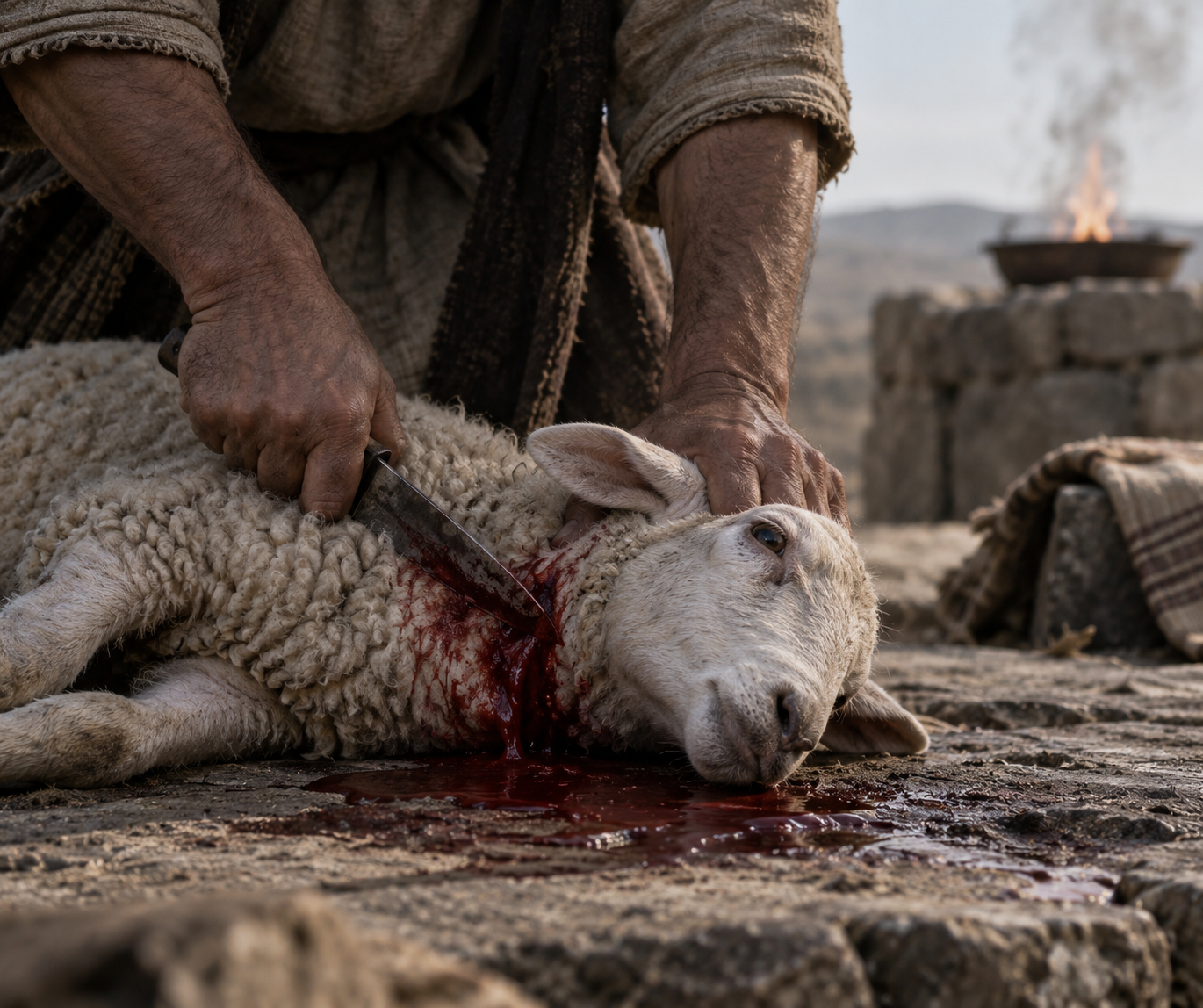
Two goats stand at the center of the ceremony. Aaron is commanded to “take two male goats for a sin offering,” and lots are cast: “one lot for the Lord and the other for the scapegoat.” One goat is sacrificed as a sin offering, and its blood is brought into the Most Holy Place. God says this blood is used to “make atonement for the Most Holy Place because of the uncleanness and rebellion of the Israelites, whatever their sins have been.” The blood is applied to the atonement cover and the altar, cleansing the holy place in the midst of a sinful people.
Then comes the second goat. Aaron is to “lay both hands on the head of the live goat and confess over it all the wickedness and rebellion of the Israelites—all their sins—and put them on the goat’s head.” The goat then “will carry on itself all their sins to a remote place.” Here the picture changes. Sin is not only dealt with in the sanctuary; it is borne away from the people.
Taken together, the ritual shows two sides of atonement. First, sin is purified through sacrificial blood in the presence of God. Second, sin is carried away into the wilderness, removed from the community. Leviticus 16 does not merely speak of forgiveness in the abstract. It gives Israel a ritual picture of cleansing and removal, of guilt dealt with before God and taken away from the people.
4. Other Hebrew Bible Methods of Atonement
The Hebrew Bible describes several other ways that atonement can happen.
One of these ways is sacrifice [Leviticus 1–7]. The book of Leviticus describes many different sacrifices that helped restore the relationship between God and his people. These sacrifices symbolized cleansing, devotion, and renewed fellowship.
Another pattern is ransom. In Exodus chapter 30, the Israelites give a payment during a census as a way of acknowledging that their lives belong to God. This payment is called a ransom.
A third pattern is intercession. After Israel worships the golden calf, Moses says, “Perhaps I can make atonement for your sin.”
The Hebrew Bible also teaches that repentance matters. Psalm 51 says God desires a broken and contrite heart. Hosea calls the people to return to the Lord.
The Prophet Isaiah also introduce another powerful image. In chapter 53 we read about the suffering servant who bears the sins of many.
When we look at all these examples together, we see something important. The Hebrew Bible does not describe atonement in only one way. Instead, it uses many images.
5. New Covenant Atonement
Roughly 600 years before the coming of Jesus the Messiah, the prophet Jeremiah. speaks about a future covenant.
Jeremiah foretells God saying to the people, “I will be their God, and they will be my people.. Everyone will know the Lord—from the least to the greatest.”
And then God explains why this will be possible:
“I will forgive their wickedness and remember their sins no more.”
In the New Testament, what Qur’ān calls the Injil, Jesus fulfills these promise.
John the Baptist points to Jesus and says, “Behold, the Lamb of God who takes away the sin of the world.” Hebrews explains that Jesus offered himself as a sacrifice once for all.
Jesus also fulfills the scapegoat imagery by suffering outside the gate.
Jesus describes his own mission in terms of ransom: “The Son of Man came to give his life as a ransom for many.”
Hebrews also describes Jesus as the great high priest who intercedes for his people.
The Apostle Peter connects Jesus directly with Isaiah’s suffering servant: “He himself bore our sins in his body on the tree.”
The New Testament therefore gathers many images together. Jesus is the sacrificial lamb. He removes sin. He is the ransom that redeems. He is the priest who intercedes. He bears the sins of others. All of these pictures come together in the person of Christ.
6. Conclusion
We began with a story about a sinful woman who believed she was accepted by Jesus. She showed her acceptance by caring for Jesus. Jesus used the opportunity to show what someone who knows their forgiven lives like. Her debt was released and her relationship with God was restored.
But forgiveness raises an important question: how can such a debt simply disappear?
The Hebrew Scriptures answer that question in many ways. In the Day of Atonement we see sin purified and carried away. In other places we see sacrifice, ransom, intercession, repentance, and even the suffering of a servant who bears the sins of others.
God gathers all of these images together and applies them to the work of Jesus. Its not surprising Jesus says, “You study the Scriptures diligently because you think that in them you have eternal life. These are the very Scriptures that testify about me, yet you refuse to come to me to have life.” (John 5:39-40 NIV)
I offer again what I think is the center of forgivenss and atonement: Are you confident right now that you are forgiven by God?
One cannot bear the burden of another
Several passages in the Qur’ān emphasize personal responsibility: “No bearer of a burden will bear the burden of another” (6:164; 17:15; 35:18; 39:7; 53:38). Yet the Qur’ān also affirms that intercession will exist for those who have a covenant with the Most High (19:87). This raises a natural question: if burdens cannot simply be transferred, what kind of intercession does God allow within His covenant? For followers of Jesus, the new covenant is precisely the means through which such intercession occurs. If God provides covenantal intercession, it is reasonable to ask why one would not want the intercession offered through that covenant.
Jesus didn’t actually die.
The Qur’ān itself has very little to say about the death of Jesus. The most discussed verse is Qur'an 4:157, which records the claim of some Jews: “We killed the Messiah, Jesus son of Mary, the messenger of God.” The verse then responds that they did not kill him or crucify him, but that it was made to appear so to them. Many readers assume this verse teaches that Jesus was never crucified. However, another Qur’ānic passage is also relevant. In Qur'an 19:33, Jesus says: “Peace be upon me the day I was born, the day I die, and the day I am raised to life.” This verse clearly presents Jesus as foreseeing his own death followed by resurrection.
If we consider the Qur’ān alone, these two verses allow more than one possible interpretation. One understanding is that Jesus was never crucified and that someone else was substituted in his place. Another interpretation is that the verse is rebuking the Jewish claim of triumph—“we killed the Messiah”—while denying that they truly defeated him. In this reading, God overturned their boast by raising Jesus, demonstrating that they did not ultimately accomplish what they claimed.
When these passages are read alongside the previously revealed scriptures, a straightforward path of interpretation emerges. The Injil repeatedly records Jesus predicting his death and resurrection. In fact, the Gospels contain many statements in which Jesus foretells that he will suffer, be killed, and then be raised on the third day. The entire narrative of the Gospel accounts centers on this event. From that perspective, Qur’ān 4:157 can naturally be understood as rejecting the claim that Jesus’ enemies successfully destroyed him, while Qur’ān 19:33 reflects Jesus’ own expectation that he would die and then be raised.
When we move from the Qur’ān to the most authoritative hadith collections, the picture is also notable. The six most widely accepted Sunni collections—known as the Sihah Sittah—do not provide a detailed explanation of how the crucifixion event occurred. They consistently affirm that Jesus was not ultimately killed and that God raised him, but they do not describe the mechanics of what happened at the crucifixion itself. In other words, the hadith literature preserves the Qur’ānic claim that God raised Jesus but does not supply the later narrative explanations that became common in later interpretation.
It is only in later tafsīr traditions that detailed theories appear, such as the idea that another person was substituted in Jesus’ place or that the crucifixion was an illusion. These explanations became influential in later Islamic thought, but they are not explicitly found in the Qur’ān itself and are not directly established by the most authoritative hadith collections. This historical development suggests that early Muslim reflection on the verse allowed for multiple ways of understanding the statement that “they did not kill him.”
Meanwhile, the Gospel tradition contains extensive material in which Jesus repeatedly predicts his suffering, death, and resurrection. These predictions shape the entire worldview of the Gospel narratives. When the Qur’ānic statements about Jesus’ death and exaltation are considered alongside these earlier scriptures, it is possible to read the Qur’ān as affirming that Jesus’ enemies did not ultimately triumph over him, while still leaving open the possibility that his death and resurrection occurred as foretold.
God doesn’t need a sacrifice in order to forgive you.
Of course, God can forgive directly. He does not need a sacrifice in order to forgive. God lacks nothing.
Yet God’s character is self-giving and sacrificial. Because God desires relationship with us, knowing Him means encountering that character.
This raises an important question: how do we know we are forgiven?
In the gospel, God reveals His justice and mercy together by sending His eternal Word in human flesh. The Messiah freely gave His life for the sins of the world.
Through this act, God provides a clear basis for our confidence that we are forgiven. When a person receives the forgiveness accomplished through the Messiah’s death, they can know that God’s mercy and justice have both been fully expressed.
Jesus dying for sinful people is unjust.
Jesus dying for sinful people would be unjust if he were merely a human prophet forced to suffer for others. But according to the New Testament, Jesus is God’s eternal Word who became human (John 1:1,14). Just as Sunni theology does not see Allah’s eternal attributes as separate from Him but merely distinguisable, Christians understand Jesus as God’s Word personally present in human life. Therefore the cross is not an innocent third party being punished, but God’s word in flesh, freely entering human suffering and giving His life.
We don’t inherit the guit of other people’s sins.
Christians have historically interpreted Romans 5:12 in two main ways. One view, strongly articulated by Augustine, teaches that all humanity sinned in Adam and therefore inherits both guilt and a sinful nature, making divine grace absolutely necessary for salvation. The other view, reflected in many early Eastern Church Fathers, holds that Adam’s sin introduced death and corruption into the world, but each person is guilty only for their own sins. In this second view, humans inherit a weakened condition rather than Adam’s legal guilt. These two views have deep roots in church tradition but most people have no knowledge of the Eastern Church Fathers.